Why I Founded The High Satanic Church
A word to the Church, from its founder
I want to tell the people of this Church a little about how I came to found it. There are things in my past that I was wrong to believe, and explaining how I got here means talking about them. It also means talking about what I was looking for in a religious community, and why I eventually decided to start one.
I grew up in a Catholic household. As I got older, I moved away from Christianity and spent several years as an atheist. During that period, while I was still fairly young, I also became involved in neo-Nazi ideology.
Most of that involvement happened in small groups where people knew one another and often considered one another friends. I was never part of a major political organisation. But those ideas occupied a real part of my life, and the small size of the circles I moved in does not make what I believed any less wrong.
Looking back, the contradictions are hard to miss. I knew nationalists, racialists, pagans and occultists, including people who somehow tried to combine Stalinism with Nazism. Some seemed to change their politics depending on whom they were talking to. Others spoke constantly about ancestry and tradition while making exceptions whenever their own lives failed to fit their beliefs.
Some of us were gay, myself included. We had attached ourselves to an ideology hostile to people like us and still found ways to explain that away. One gay man I knew was openly hostile to trans people. Being on the receiving end of one prejudice did not stop us from holding another. I can see that much more clearly now than I could then.
Around the same period, I became interested in the occult. During a holiday, mostly out of boredom and while I was not doing particularly well personally, I attempted a ritual connected to the Order of Nine Angles, usually called the O9A.
I came away from that experience convinced that Satan was real, along with the beings I understood as the Dark Gods. After years of atheism, that was a considerable change. Someone else might interpret the experience psychologically or reach a different spiritual conclusion. I can only tell you what it meant to me: I began taking theistic Satanism seriously and trying to work out how to practise it.
For a long time, I did that mostly alone. I downloaded PDFs through torrents, searched the Internet Archive, read obscure WordPress sites and old websites, and worked through scanned books. Much of my religious education consisted of reading whatever I could find and trying to make sense of it.
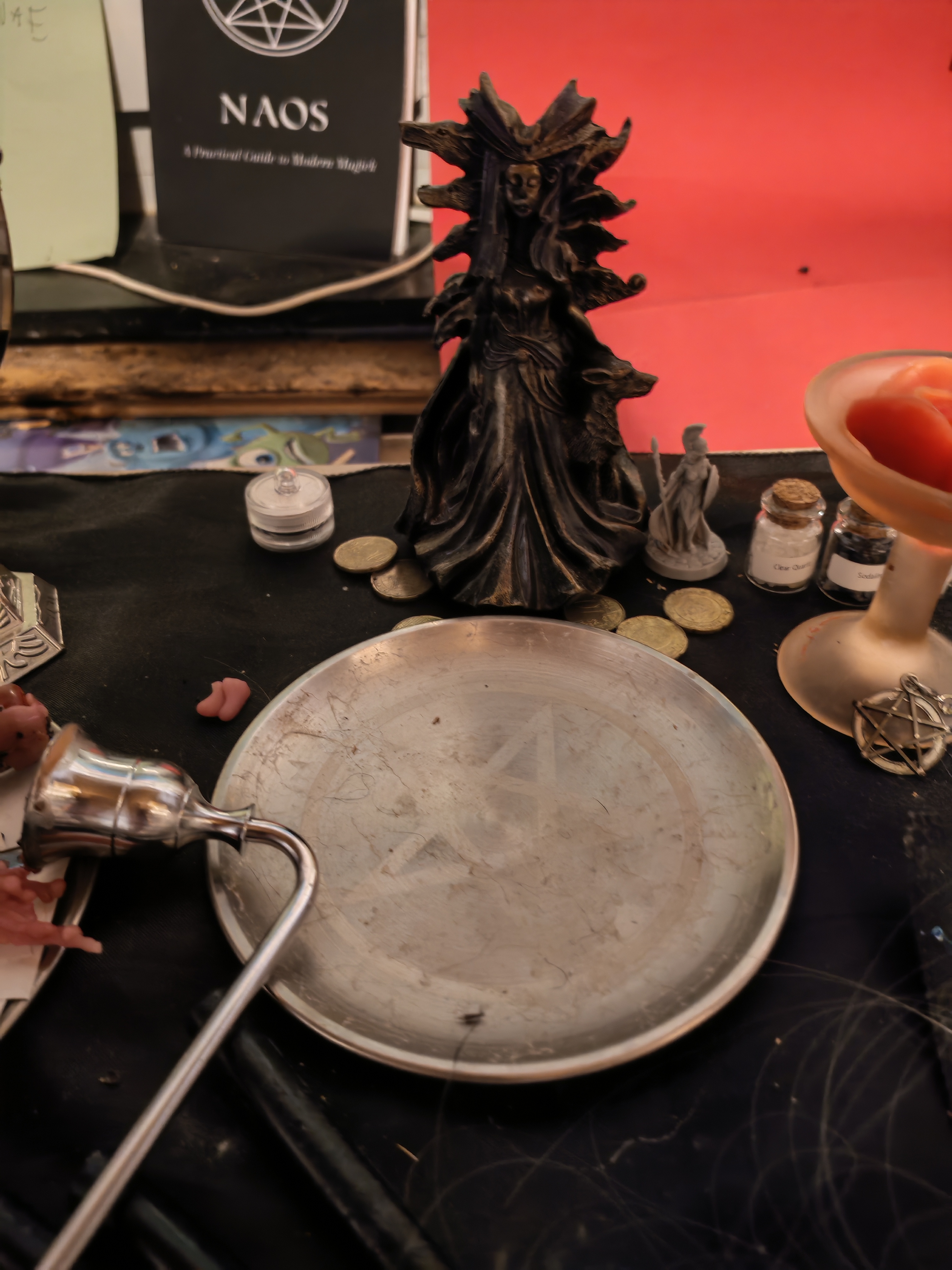
My practice was already becoming broader than the O9A material. Before I formed a nexion, I had begun exploring Hellenic practice, particularly devotion to Hekate. She remained important to me through the changes that followed, and I still worship her today. I did not feel that everything I experienced had to fit into one closed religious system.
Eventually, I became more directly involved with people connected to the O9A world and formed a small group, a nexion. That group later fell apart. I will keep the other people involved, and the circumstances of its ending, private.
Afterward, I gradually moved away from those circles. My belief in Satan remained, and I continued exploring Hellenic paganism, Wicca and other occult traditions. I met people who were calmer and less absorbed in extremist politics. There was more room to talk about religion without every conversation returning to the same obsessions.
I also began getting to know people whom my former beliefs had reduced to stereotypes. That included Jewish people. The people I met bore little resemblance to the conspiratorial picture I had accepted. Many were kind and easy to talk to. In my own experience, some were easier to be around than many of the Christians I had known.
Their kindness should never have been something they needed to offer in order to deserve my respect. I had been wrong about them before we ever spoke. Getting to know them helped me confront that. Something similar happened with other people I had been encouraged to hate, including Slavic, Indian and Black people.
The worldview I had accepted became harder to sustain. A piece of information that happened to be true could be surrounded by conspiracy theories and selective history until it seemed to support something it did not. I had mistaken that for understanding. There was also the constant need for an enemy, and the habit of excusing in ourselves what we condemned in others.
Leaving those beliefs behind happened gradually. I am still occasionally in contact with one person from that period who also moved away from them. I mention this because I know people can change, though I cannot undo the fact that I once believed those things myself.
As I reconsidered my politics, I also became more critical of the religious communities I encountered. I wanted to practise theistic Satanism with other people. Finding a community where I felt able to do that was harder than I had expected.
I was tired of religion being used to recruit people into politics. I had seen how easily interest in Satanism or the occult could become an entry point into racial extremism. I also disliked the expectation, wherever it appeared, that belonging to a religious group meant adopting a whole package of unrelated political opinions.
The Church I wanted would have room for people with different backgrounds and views. A Black person, a Jewish person, a gay person or a trans person should be able to take part without discovering that the organisation quietly considers them inferior. There have to be expectations about how we treat one another, including a clear rejection of racial hatred and harassment. Within those boundaries, people should be able to disagree. I had no interest in building another circle where everybody needed the same enemies in order to belong.
Money was another frustration. I came across expensive memberships, costly initiation systems and books priced at hundreds of euros. I understand that books cost money to produce and organisations have expenses. Donations and reasonable charges for actual work do not offend me. What bothered me was the feeling that a person with little money could be kept permanently outside the parts of a religion they wanted to understand. I wanted people to be able to learn and practise without needing a large disposable income.
Sometimes the difficulty was simply theological. The Temple of Set, for example, centres Set. My own worship is directed toward Satan as a real being, and Setianism was not the religious home I was looking for. That does not make it worthless. I can respect another organisation without wanting to join it or expecting it to change its beliefs for me.
I have also found the Grigorist Temple of Satanael interesting. My contact with them has mostly been by email about the wiki. I have also done some further research into the group. They have been polite with me, which is more than I can say for quite a few groups I have dealt with. Our understanding of Satan differs in places, but I appreciate the courtesy they have shown in those exchanges.
Then there was the atmosphere in some communities. I found the constant seriousness exhausting. A person could be tired, make an awkward joke or misunderstand something, and an ordinary conversation would turn unpleasant. Sometimes there seemed to be very little room to enjoy the company of the people you were supposed to share a religion with.
I like being able to laugh. I want to be able to talk nonsense with friends sometimes. A serious conversation about ritual or theology can matter a great deal without requiring everyone to stay solemn for the rest of the evening. If somebody is having a bad day, I would rather they found a little patience in their religious community than another reason to feel worse.
Eventually, I founded The High Satanic Church because I wanted somewhere these things could exist together. Worship of Satan would be central. People could study and practise without racial politics deciding whether they belonged, or money deciding how far they were allowed to get. There would be room for difficult questions and for ordinary friendship. I wanted to belong to that kind of Church myself.
I work on the Church every day, usually for about eight hours, writing texts, coding or working on the website. I don't have much else to do at the moment, so a lot of my time goes into it.
The social side is much harder for me. I am not very good at talking to new people, even when I would like to get to know them. Wanting to build a community has not made those conversations come naturally. If I seem quiet or awkward, I hope you will keep that in mind. I care about the people here; I find it easier to sit down and work on something than to introduce myself and start talking.
There is also something personal I want our congregation to understand. I intend to keep my identity outside the Church private for the rest of my life. That is a deliberate decision about my safety, and it affects how much of my history I can share.
When someone in everyday life asks what I practise, I generally say Wicca. I have explored Wicca, but that answer leaves out my devotion to Satan. I give it because it feels safer than saying I am a Satanist to someone whose reaction I cannot predict.
Recently, while I was spending time with friends who know about my beliefs, a friend of a friend told me that if he did not know I was a good person, he would beat me up for being a Satanist. The fact that he made an exception for me did not make it reassuring.
That is the sort of reaction I have to think about before speaking openly. Even saying something favourable about Satan can feel risky. I would like to be able to answer a simple question about my religion without first wondering whether the answer will put me in danger.
The name I use in the Church is one people in my everyday life do not normally know me by. I use it here to keep some separation between my religious work and my private life. I ask you to respect that separation, including the details I leave out of accounts like this one.
I can speak honestly about what I believe while keeping those limits. Founding a Church has not made the possible consequences of disclosure disappear. I still have to live with them once I step away from the screen.
If you also keep your practice private, I want you to know that I understand. I would never ask you to risk being hurt to prove that your devotion is sincere. You should be able to decide for yourself who knows your name, sees your face or hears about your religious life. Please give other members that same choice. We may know very little about the circumstances they return to after a conversation with us.
My own history also gives people reasons to ask difficult questions. I accept that. I believed things I now reject, and I spent time in circles I would never want this Church to reproduce. I am responsible for those choices even where I have decided to keep personal details private. Founding the Church does not erase them.
For those of you who have joined us, I hope this helps explain why the Church matters to me. I am glad you are here. Alongside the worship and the work of building a community, I hope we can enjoy being part of it together.